
‘Completely electric’: How Diego Maradona’s legendary Argentina career came to dramatic end at Foxboro Stadium
Before what ultimately became his final game for Argentina, Diego Maradona was training with his teammates at Babson College, reminding those in attendance why he was once considered the greatest player in the world.
Maradona and the Argentines were here for the 1994 World Cup, where they played two games at Foxboro Stadium, and they had set up their headquarters at Babson. And in an otherwise ordinary training session, Maradona, as he routinely did, wowed his onlookers during one drill. Gus Martins, a former sportswriter at the Herald who was covering the 1994 World Cup, remembers it vividly.
“It’s a goalkeeper punt, and it goes 60 yards and it’s high, and as it’s descending, you see Maradona and he’s surrounded by a few teammates, and they’re all jockeying for the ball,” Martins recalled. “And he sticks his left foot out and he kills the ball. It’s like the ball dropping into Willie Mays’ glove, you know what I mean? It just stayed on his foot, and he wasn’t alone. He’s in the midst of a lot of guys, so you see this kind of pinpoint control of the ball that was just astounding. …
“Like, if he’s alone and he has all this time to concentrate, it’s one thing. But he’s got two or three guys around him, and everyone’s trying to get the ball, and he gets it and brings the ball down like it was nothing. …
“You just shook your head. Unbelievable. The greatest player I ever saw.”
It became some of his last bits of brilliance with Argentina. Perhaps somewhat of a footnote in his legendary career, Maradona — who died at the age of 60 on Nov. 25 after a series of health issues — actually played his final two games for the Argentina national team at the old Foxboro Stadium, a site of the 1994 World Cup.
But though he was a catalyst in two Argentina victories, Maradona’s end here was far from ceremonious. Just prior to Argentina’s third and last group stage game, which was played in Dallas, FIFA announced that Maradona had tested positive for ephedrine, a banned substance, which disqualified him from the tournament.
Maradona, who famously carried Argentina to a World Cup title in 1986 and led them to a runner-up finish in 1990, never played another game in his iconic blue and white No. 10 jersey. His goal in Argentina’s tournament-opening 4-0 win over Greece proved to be his last, and Argentina’s ensuing 2-1 victory over Nigeria marked his final international game.
“Diego Maradona was one of the most iconic athletes in the world,” said Robert Kraft, who had just bought the Patriots and attended all the World Cup games when Maradona came to Foxboro, before becoming a founding investor of Major League Soccer due to the success of that World Cup. “In Argentina, he was a sports hero. A living legend. Much like our fans viewed Tom Brady. Maradona transcended sports. He was internationally renowned. I was very proud to host the World Cup at Foxboro Stadium and I attended all of the matches. The crowds were amazing. I don’t think the fans ever sat down. We were fortunate to have some great draws.
“Obviously, I didn’t realize it at the time, but looking back I love that I am able to say that I saw Maradona’s last goal for Argentina against Greece right here in Foxboro. And a few days later, I saw the last game he ever played for Argentina just before his suspension. I enjoyed a number of memorable moments at Foxboro Stadium. Those are certainly among them.”
Maradona in Foxboro could have easily never happened.
For one, there was real concern that Boston wouldn’t be awarded a bid. But Steve Gans, a Boston-based lawyer who was then a young associate at Goulston and Storrs, which represented Foxboro Stadium, was asked to help revive the bid’s effort, one he said was initially ranked 29th out of 29 potential host cities. But after a long process, which included a meeting with Kraft, who was then a part owner of Foxboro Stadium, and re-assessing and re-strategizing the bid effort, Boston and Foxboro Stadium were ultimately picked as one of nine host cities.
Then there was Maradona, who had served a 15-month suspension in 1991 and 1992 for a positive drug test traced to his cocaine use while playing in Italy. When he returned, he was clearly on the decline of his career. But he still had a little left.
Argentina almost missed qualification for the 1994 World Cup, and needed to beat Australia in a two-legged playoff to get there. That’s when Maradona, who wasn’t in great playing shape, came out of international retirement, ending about a three-year hiatus from La Albiceleste, to help them beat the Australians.
“Even a heavy, out-of-shape, overweight Maradona can give a team a lot of confidence, and he did that,” Martins said. “He played well. He didn’t have his mobility, but he played well.”
Maradona needed to lose weight to be ready for the World Cup, but he got there. When he and the Argentines arrived at Foxboro Stadium in June 1994, it was a huge event. A crowd of 54,456 filled the stadium for their first match. Argentine fans brought confetti, and there was excitement in the air, not only because it was the first World Cup on U.S. soil, but because Maradona was in the house.
“The place was very, very loud,” Martins said. “They brought real intense energy. … You know they were there. They were there in big numbers. …
“It was a real event. When (Maradona) played, there was a real buzz. I mean, there was a real buzz for mostly all the games, but this was a different guy. Just a once-in-a-lifetime player.”
Gans said the stadium was split between diehard soccer fans and fans who were less knowledgeable about the sport, but were there for the spectacle of a big event like the World Cup. One thing was certain: There was real Maradona fever.
“There was a buzz and certainly a lot of those people had heard of Maradona, the former world’s greatest player,” Gans said. “Total energy and electricity.”
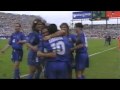
Although Maradona was 33 and nearing the end of his career, he did not disappoint. Argentina led 2-0 in the 60th minute when their captain delivered one of the most iconic goals — and ultimately his last for his country — of the tournament, as he found some space on his left foot atop the 18-yard box, and fired a perfect shot into the upper left corner.
In a memorable scene, Maradona raced to the sideline and screamed into one of the TV cameras as his teammates mobbed him. Gans was there with his dad, who he said had tears in his eyes to see a World Cup, and they were in good position in lower loge seats to see the goal. He cherished the moment.
“That was a classic Maradona goal,” Gans said. “He was in tight space, made a quick give and go, got the ball at the top of the box, made space. Space was closing and he ripped off a shot. It was a great goal. …
“The whole stadium just erupted when he scored. It was completely electric. It was just an incredible moment.”
As electric as Maradona playing in Foxboro was, his abrupt end was even more stunning. The Argentines ultimately couldn’t recover from the loss of their hero, losing their last group stage match to Bulgaria before getting knocked out of the tournament with a 3-2 loss to Romania in the Round of 16.
Maradona was administered the random drug test immediately after Argentina’s 2-1 win over Nigeria in Foxboro, and the positive test was announced during a news conference six hours before Argentina’s next game against Bulgaria. Maradona was obviously devastated, reportedly telling a Buenos Aires TV station, “They have retired me from soccer. I don’t think I want another revenge, my soul is broken.”
“It was pretty dramatic, quite honestly,” Gans said. “And that’s where it ended.”
There was some controversy over the drug test result and subsequent ban. In his autobiography, Maradona later argued that he ingested ephedrine in the power drink Rip Fuel, which was provided by his personal trainer that some speculated helped him lose weight to get ready for the World Cup. He claimed that the stimulant was not included in the Argentinian version of the drink, but was in the U.S. version he took.
Either way, it was a shocking and sad end to his international career. It was likely that 1994 would be Maradona’s final World Cup anyway, but no one saw it ending like it did.
“He was probably fighting age, but you get to a point where you’ve taken a lot of knocks, you’re fighting weight and he was always fighting addiction,” Martins said. “He had a lot of demons, that run of cocaine and alcohol, and I think that was always with him and I don’t know if he was ever completely free of it. …
“By 33, he’s already probably like 48 in some other parallel life. He lived a 24/7 life. You can only do that so long. … I think he knew that was it for him. It remains a narrative of what could have been. It’s sad.”
from Boston Herald https://ift.tt/3ghhDZ5
 Reviewed by Admin
on
December 06, 2020
Rating:
Reviewed by Admin
on
December 06, 2020
Rating:
Post a Comment